
Tire wear

Tire rotation
Your vehicle has no required tire rotation. Tire wear is affected by a number of factors such as tire inflation, ambient temperature, driving style, etc.
NOTE
• If the tires are rotated, they should only
be moved from front to rear or vice
versa. They should never be rotated left
to right/right to left.
• Ideally, tire rotation should be done the
first time after approximately 3,000
miles (5,000 km) and thereafter at
6,000-mile (10,000-km) intervals. Some
customers find that tire rotation may
help to get extra mileage from tire life.
• Tire rotation should only be performed
if front/rear tire wear is fairly even and
tread height is above 1/16" (1.6 mm).
Your Volvo retailer can also provide guidance based on your particular driving circumstances.
Tread wear indicator
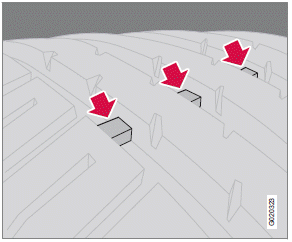
The tires have wear indicator strips running across or parallel to the tread. The letters TWI are printed on the side of the tire. When approximately 1/16" (1.6 mm) is left on the tread, these strips become visible and indicate that the tire should be replaced. Tires with less than 1/16" (1.6 mm) tread offer very poor traction.
When replacing worn tires, it is recommended that the tire be identical in type (radial) and size as the one being replaced. Using a tire of the same make (manufacturer) will prevent alteration of the driving characteristics of the vehicle.
See also:
Tire Pressure Monitoring System (TPMS)
Introduction
NOTE
USA – FCC ID: KR5S122780002
This device complies with part 15 of the
FCC rules. Operation is subject to the following
conditions: (1) This device may not
cause harmful inter ...
Overview
1 Screen: channel A (left), channel B (right)
2 Headphone socket
3 On/Off button
4 A/V-AUX socket
5 Remote control
6 Headphones
7 IR transceiver ...
Scanning audio files on an external device
This function plays the first ten seconds of each audio file. This function can
be activated/ deactivated under: Bluetooth menu Scan. ...