
Blind Spot Information System

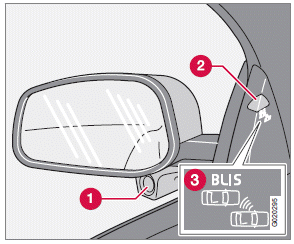
1 BLIS camera
2 Indicator light
3 BLIS symbol
The Blind Spot Information System (BLIS) is an information system that indicates the presence of another vehicle moving in the same direction as your vehicle in the side-view mirror's "blind area." The system is based on digital camera technology.
The cameras (1) are located beneath the side-view mirrors.
When one (or both) of the cameras have detected a vehicle in the blind area (up to approximately 10 ft. (3 meters) from the side of your vehicle, and up to approximately 31 ft.
(9.5 meters) behind the side-view mirror), see the illustration, the indicator light in the door panel (2) illuminates. The light will glow continuously to alert the driver of the vehicle in the blind area.
WARNING
• BLIS is an information system, NOT a
warning or safety system.
• BLIS does not eliminate the need for
you to visually confirm the conditions
around you, and the need for you to turn
your head and shoulders to make sure
that you can safely change lanes.
• As the driver, you have full responsibility
for changing lanes in a safe manner.
NOTE
The door panel indicator light illuminates on
the side of the vehicle where the system has
detected another vehicle. If your vehicle is
passed on both sides at the same time, both
lights will illuminate.
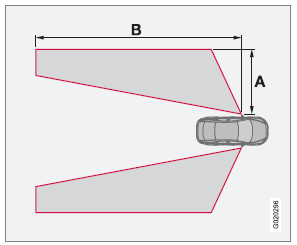
Areas monitored by BLIS
Distance A = approx. 10 ft. (3 meters)
Distance B = approx. 31 ft. (9.5 meters)
BLIS has an integrated function that alerts the driver if a fault should occur with the system.
For example, if one or both of the system's cameras are obscured, a message will appear in the information display in the instrument panel. If this occurs, clean the camera lenses. If necessary, the system can be temporarily switched off (for instructions)
See also:
Main CD/DVD Data menu
Disc menu
Play/Pause
Stop
Random
Repeat folder
Change subtitles
Change audio track
Scan
Audio settings ...
Messages
When a warning, information or indicator symbol comes on, a corresponding message
appears on the information display. An error message is stored in a memory list
until the fault is rectified.
P ...
Audible signal
The Park Assist system uses an intermittent tone that pulses faster as you come
close to an object, and becomes constant when you are within approximately 1 ft
(30 cm) of an object in front of or ...