
Start
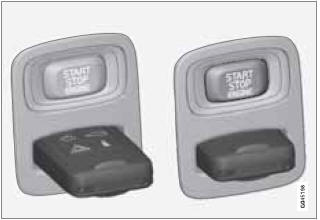
Ignition switch with remote key inserted ( see page 82 for more information
on ignition modes)
WARNING
Before starting the engine:
• Fasten the seat belt.
• Check that the seat, steering wheel and
mirrors are adjusted properly.
• Make sure the brake pedal can be
depressed completely. Adjust the seat
if necessary.
WARNING
• Never use more than one floor mat at a
time on the driver's floor. An extra mat
on the driver's floor can cause the
accelerator and/or brake pedal to
catch. Check that the movement of
these pedals is not impeded.
• Volvo's floor mats are specially manufactured
for your car. They must be
firmly secured in the clips on the floor so
that they cannot slide and become trapped
under the pedals on the driver's
side.
1. Press the remote key into the ignition slot as far as possible, with the metallic key blade pointing outward (not inserted into the slot).
2. Depress the brake pedal.
3. Press and release the START/STOP ENGINE button. The autostart function will operate the starter motor until the engine starts or until its overheating function stops it.
The starter motor operates for a maximum of 10 seconds. If the engine has not started, repeat the procedure.
NOTE
Keyless drive
To start a vehicle equipped with the keyless
drive feature, one of the remote keys must
be in the passenger compartment. Follow
the instructions in step 3 to start the vehicle.
WARNING
• Always remove the remote key from the
ignition slot when leaving the vehicle,
especially if there are children in the
vehicle.
• Never open the driver's door while driving
or when the vehicle is being towed.
The steering lock could otherwise be
activated, making it impossible to steer
the vehicle. On vehicles with the
optional keyless drive, never remove
the remote key from the vehicle while
driving or during towing.
• Always place the gear selector in Park
and apply the parking brake before
leaving the vehicle. Never leave the
vehicle unattended with the engine running.
• Always open garage doors fully before
starting the engine inside a garage to
ensure adequate ventilation. The
exhaust gases contain carbon monoxide,
which is invisible and odorless but
very poisonous.
NOTE
• After a cold start, idle speed may be
noticeably higher than normal for a
short period. This is done to help bring
components in the emission control
system to their normal operating temperature
as quickly as possible, which
enables them to control emissions and
help reduce the vehicle's impact on the
environment.
CAUTION
• When starting in cold weather, the automatic
transmission may shift up at
slightly higher engine speeds than normal
until the automatic transmission
fluid reaches normal operating temperature.
• Do not race a cold engine immediately
after starting. Oil flow may not reach
some lubrication points fast enough to
prevent engine damage.
• The engine should be idling when you
move the gear selector. Never accelerate
until after you feel the transmission
engage. Accelerating immediately after
selecting a gear will cause harsh
engagement and premature transmission
wear.
• Selecting P or N when idling at a standstill
for prolonged periods of time will
help prevent overheating of the automatic
transmission fluid.
See also:
SIRIUS ID
The SIRIUS ID (sometimes referred to as the Electronic Serial Number or ESN)
is required when contacting the Sirius Call Center. It is used to activate your
account and when making any account tra ...
Children should be seated safely
Volvo recommends the proper use of restraint
systems for all occupants including children.
Remember that, regardless of age and size, a
child should always be properly restrained in a
vehicle.
...
Driver Alert Control (DAC)– introduction
This function is intended to alert the driver if his/her driving becomes erratic,
such as if the driver is distracted or fatigued.
NOTE
The camera has certain limitations, see page 160.
A ...