
Child restraint systems
Child restraints
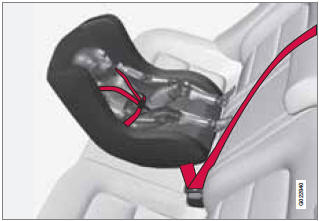
Infant seat
There are three main types of child restraint systems: infant seats, convertible seats, and booster cushions. They are classified according to the child's age and size.
The following section provides general information on securing a child restraint using a three-point seat belt. Refer to page 47–48 for information on securing a child restraint using ISOFIX/LATCH lower anchors and/or top tether anchorages.
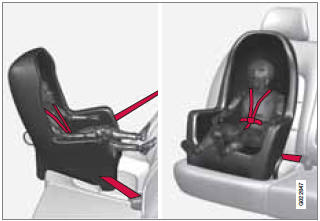
Convertible seat
WARNING
A child seat should never be used in the
front passenger seat of any vehicle with a
front passenger airbag – not even if the
"Passenger airbag off" symbol near the
rear-view mirror is illuminated (on vehicles
equipped with Occupant Weight Sensor). If
the severity of an accident were to cause the
airbag to inflate, this could lead to serious
injury or death to a child seated in this position.
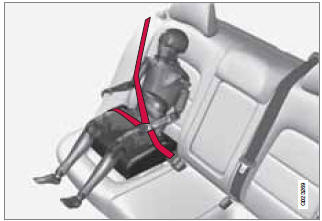
Booster cushion
WARNING
Always refer to the child restraint manufacturer's
instructions for detailed information
on securing the restraint.
WARNING
• When not in use, keep the child restraint
system secured or remove it from the
passenger compartment to help prevent
it from injuring passengers in the
event of a sudden stop or collision.
• A small child's head represents a considerable
part of its total weight and its
neck is still very weak. Volvo recommends
that children up to age 4 travel,
properly restrained, facing rearward. In
addition, Volvo recommends that children
should ride rearward facing, properly
restrained, as long as possible.
See also:
Navigating a disc and playing tracks
CD audio discs
Turn TUNE to access the disc's playlist and to
navigate in this list. Press OK/MENU to confirm
a choice and begin listening. Press EXIT
to cancel. Press and hold EXIT to return t ...
Limitations
In certain situations, the BLIS indicator light(s)
may illuminate even when there are no other
vehicles in the area monitored by the system.
NOTE
If the BLIS indicator lights illuminate occasion ...
Call settings
While a call is in progress, press OK/MENU or the thumb wheel on the steering
wheel keypad to access the following functions:
Mute: mute the infotainment system’s microphone.
Mobile phone: tra ...