
Design concept
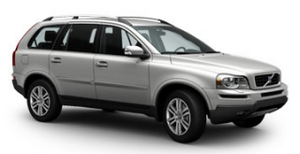
At the front, the traditional Volvo V-shaped bonnet incorporates a grille with a wide chrome surround and three-dimensional mesh inserts, plus a large Volvo 'iron mark' badge. The front bumper has a degree of colour-coding and an extended skidplate built into it. The Volvo XC90 is also distinguished by 18in alloy wheels (standard on SE and SE Lux) and colour-coded side mouldings, door handles and wheelarch mouldings with black stone protectors. In line with the rest of the Volvo range, the Volvo XC90 also features large, body-coloured door mirrors, which incorporate the side indicator lights.
The muscularity of the Volvo XC90 is matched by rounded corners front and rear, a gently sloping (split) tailgate and shorter roof section to promote a smoother, non-aggressive impression and help the vehicle to look more compact and desirable.
The Volvo XC90's 'cockpit forward design' enables the passenger compartment to be as far forward as possible with a more steeply raked windscreen than in most other SUVs. This has allowed Volvo to make a seven-seat SUV within modest overall body dimensions.
The Volvo XC90's tailgate is gently sloping rather than vertical to clearly state that this is not a regular Volvo estate car. The resulting shorter roofline also helps the vehicle appear smaller and gives it a sporty stance.
For added convenience, the tailgate is split so the lower section can be used as a seat or table; it is strong enough to be stood upon when loading items onto the roof, and the upper section is not too large, heavy or high when opened.
See also:
Load carriers (accessory)
Positioning load carriers
If wing-shaped load carriers are used, make
sure that they are installed on the roof rails with
the rounded edge forward. Load carriers of this
type are identical and can ...
Alarm
The alarm is automatically armed whenever
you lock your vehicle.
When armed, the alarm continuously monitors
a number of points on the vehicle. The following
conditions will set off the alarm:
...
Park position (P)
Select the P position when starting or parking.
Shiftlock
When P has been selected, the transmission is
mechanically blocked in this position. The
brake pedal must be depressed and the ignition ...