
The alarm system
The alarm is automatically armed whenever the vehicle is locked with the remote key or optional Personal Car Communicator.
When armed, the alarm continuously monitors a number of points on the vehicle. The following conditions will trigger the alarm:
• The hood is forced open.
• The tailgate is forced open.
• A door is forced open.
• The ignition slot is tampered with.
• An attempt is made to start the vehicle with a non-approved key (a key not coded to the car's ignition).
• If there is movement in the passenger compartment (if the vehicle is equipped with the accessory movement sensor).
• The vehicle is lifted or towed (if the vehicle is equipped with the accessory inclination sensor).
• The battery is disconnected (while the alarm is armed).
• The siren is disconnected when the alarm is disarmed.
A message will appear in the information display if a fault should occur in the alarm system.
Contact a trained and qualified Volvo service technician.
NOTE
Do not attempt to repair any of the components
in the alarm system yourself. This
could affect the insurance policy on the
vehicle.
The alarm indicator light
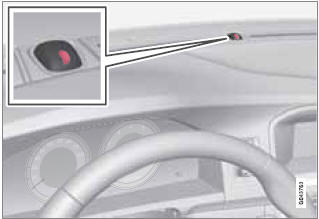
The alarm indicator light
The status of the alarm system is indicated by
the red indicator light on the dashboard (see
illustration):
• Indicator light off – the alarm is not armed
• The indicator light flashes at one-second
intervals – the alarm is armed
• The indicator light flashes rapidly before
the remote key is inserted in the ignition
slot and the ignition is put in mode I—the
alarm has been triggered.
See also:
Electrical system
General information
12 volt system with a voltage-regulated alternator. Single pole system in which
the chassis and engine block are used as conductors. The negative terminal is connected
to the ...
Fog on the inside of the windows
The defroster function should be used to
remove fog or mist from the inside of the windows.
Keeping the windows clean with a commercially
available window washing spray will
also help prevent f ...
Style
There are three C70 T5 trim levels: base, Premier Plus and Platinum. Our test
car was a Platinum with the Inscription option package. The Platinum trim
includes a number of exterior and interior a ...