
Tire designations
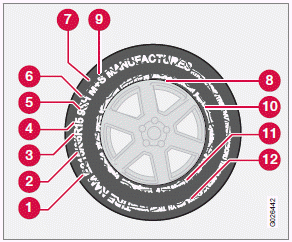
Federal law mandates that tire manufacturers place standardized information on the sidewall of all tires (see the illustration).
The following information is listed on the tire sidewall:
The tire designation:
NOTE
Please be aware that the following tire designation
is an example only and that this
particular tire may not be available on your
vehicle.
1 215: the width of the tire (in millimeters)
from sidewall edge to sidewall edge. The
larger the number, the wider the tire.
2 65: The ratio of the tire's height to its width
in percent.
3 R: Radial tire.
4 15: The diameter of the wheel rim (in
inches).
5 95: The tire's load index. In this example, a
load index of 95 equals a maximum load of
1521 lbs (690 kg).
6 H: The tire's speed rating, or the maximum
speed at which the tire is designed to be
driven for extended periods of time, carrying
a permissible load for the vehicle, and
with correct inflation pressure. For example,
H indicates a speed rating of 130 mph
(210 km/h).
NOTE
The tire's load index and speed rating may
not appear on the sidewall because they are
not required by law.
7 M+S or M/S = Mud and Snow; AT = All
Terrain; AS = All Season
8 U.S. DOT Tire Identification Number
(TIN): This begins with the letters "DOT"
and indicates that the tire meets all federal
standards. The next two numbers or letters
are the plant code where it was manufactured,
the next two are the tire size code
and the last four numbers represent the
week and year the tire was built. For example,
1510 means that the tire was manufactured
during week 15 of 2010. The numbers
in between are marketing codes used
at the manufacturer's discretion. This information
helps a tire manufacturer identify a
tire for safety recall purposes.
9 Tire Ply Composition and Material
Used: Indicates the number of plies indicates
or the number of layers of rubbercoated
fabric in the tire tread and sidewall.
Tire manufacturers also must indicate the
ply materials in the tire and the sidewall,
which include steel, nylon, polyester, and
others.
10 Maximum Load: Indicates the maximum
load in pounds and kilograms that can be
carried by the tire. Refer to the vehicle's tire
information placard located on the B-Pillar
or the driver's door for the correct tire pressure
for your vehicle.
11 Treadwear, Traction, and Temperature
grades
12 Maximum permissible inflation
pressure: the greatest amount of air pressure
that should ever be put in the tire. This
limit is set by the tire manufacturer.
Tire suppliers may have additional markings, notes or warnings such as standard load, radial tubeless, etc.
See also:
Pedestrian safety
The Volvo V50 Sportswagon has been designed to minimise the risk of injury to
pedestrians and cyclists in the event of an accident. The smoothly shaped front
has an energy-absorbing structure ahea ...
Anti-lock Brake System (ABS)
The ABS system in your vehicle performs a
self-diagnostic test when the vehicle first reaches
the speed of approximately 12 mph
(20 km/h). The brake pedal will pulsate several
times and a sound ma ...
Introduction
Volvo recommends the use of Volvo trailer hitches that are specially designed
for the vehicle.
NOTE
See page 337 for the maximum trailer and tongue weights recommended by Volvo.
Observe t ...