
Infant seats
Securing an infant seat with a seat belt
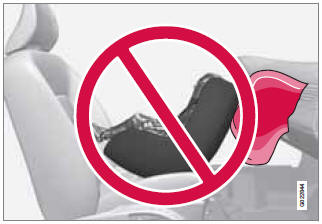
Do not place the infant seat in the front passenger's seat
 NOTE
NOTE
Refer to page 49–50 for information on securing a child restraint using ISOFIX/ LATCH lower anchors and/or top tether anchorages.
1. Place the infant seat in the rear seat of the vehicle.
2. Attach the seat belt to the infant seat according to the manufacturer's instructions.
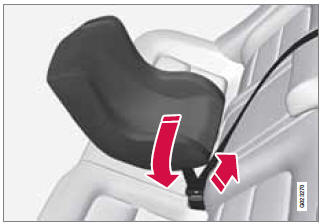
Positioning the seat belt through the infant seat
 WARNING
- An infant seat must be in the rear-facing position only.
- The infant seat should not be positioned behind the driver's seat unless there is adequate space for safe installation.
WARNING
A child seat should never be used in the front passenger seat of any vehicle with a front passenger airbag – not even if the "Passenger airbag off" symbol near the rear-view mirror is illuminated (on vehicles equipped with Occupant Weight Sensor). If the severity of an accident were to cause the airbag to inflate, this could lead to serious injury or death to a child seated in this position.
3. Fasten the seat belt by inserting the latch plate into the buckle (lock) until a distinct click is audible.
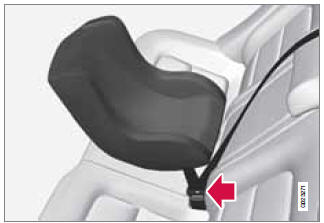
Fasten the seat belt
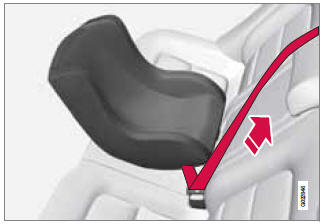
Pull out the shoulder section of the seat belt
4. Pull the shoulder section of the seat belt out as far as possible to activate the belt's automatic locking function.
NOTE
The locking retractor will automatically release when the seat belt is unbuckled and allowed to retract fully.
5. Press the infant seat firmly in place, let the seat belt retract and pull it taut. A sound from the seat belt retractor's automatic locking function will be audible at this time and is normal. The seat belt should now be locked in place.
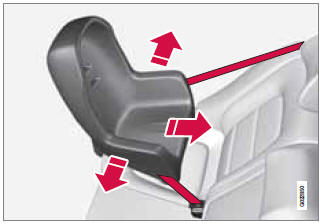
Ensure that the seat is securely in place
6. Push and pull the infant seat along the seat belt path to ensure that it is held securely in place by the seat belt.
WARNING
It should not be possible to move the child restraint (child seat) more than 1 in. (2.5 cm) in any direction along the seat belt path.
The infant seat can be removed by unbuckling the seat belt and letting it retract completely.
See also:
Auto
The function automatically
regulates cooling, heating, blower speed, recirculation, and air distribution to
maintain the chosen temperature. If you select one or more manual functions, the
other ...
Hoisting the vehicle
If a garage jack is used to lift the vehicle, the two jack attachments points
should be used.
They are specially reinforced to bear the weight of the vehicle. A garage jack
can also be placed u ...
Interior
Yes, I've already mentioned the S60's copper color, and I might have
mentioned how much I really liked it. Well, guess what? The S60's interior is
copper, too. Actually, it's called Beechwood Brow ...