
Vehicle Overview
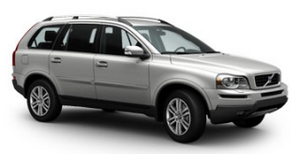
Long known for safe, solid sedans and wagons, Volvo joined the sport utility vehicle fray in 2003 with its car-based XC90. The Swedish automaker promised the ride and handling of a passenger car. Volvo also claimed that the XC90 would be the safest SUV on the market. It features a Roll Stability Control System. In a collision, the front suspension subframe is compatible with a regular car.
The premium midsize XC90’s chassis is based on the one used for Volvo’s S60 and S80 sedans. Available all-wheel drive permits operation in a variety of terrains, but the XC90 is not intended for serious offroad driving. When the front wheels begin to slip, up to 65 percent of engine power is diverted to the rear wheels.
For 2004, new 17-inch Aquarius alloy wheels are used, the flip-style key has an integrated remote control, and a leather gearshift knob has been added. Volvo offers 2.5T and T6 editions.
See also:
Function check
All indicator and warning symbols light up in ignition mode II or when the engine
is started. When the engine has started, all the symbols should go out except the
parking brake symsymbol, which o ...
ABS with EBD (Electronic Brake ForceDistribution)
EBD is an integrated part of the ABS system.
EBD regulates the hydraulic pressure to the
rear brakes to help provide optimal braking
capacity. The brake pedal will pulsate during
braking, which ...
Opening the tailgate manually
Opening the tailgate manually
The tailgate is held closed by an electronic
locking mechanism. To open:
1. Press lightly on the rubberized plate under
the handle to release the lock.
2. Lift t ...