
Pedestrians
The system cannot identify all pedestrians
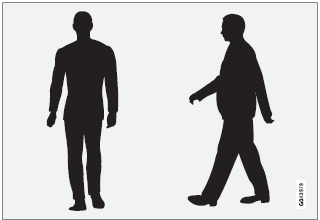
The Collision Warning system can only identify and detect a pedestrian who is standing upright. This person can be standing still, walking or running.
This means that the system has to be able to identify a person's head, arms, shoulders, legs, the upper and lower parts of the body and a person's pattern of movement when walking or running.
If parts of the body are not visible to the camera, the system cannot detect the pedestrian.
The following conditions apply:
• In order to detect a pedestrian, the system must have a full view of the person's entire body and the person must be at least 32 in. (80 cm) tall.
• The system cannot detect a pedestrian carrying a large object.
• The camera's capacity to see a pedestrian at dawn or dusk is limited, much as it is for the human eye.
• The camera's function is deactivated and will not detect a pedestrian in darkness or in tunnels, even if there is street lighting in the area.
WARNING
• Collision Warning with Full Auto-brake
and Pedestrian Detection is designed to
be a supplementary driving aid. It is not,
however, intended to replace the driver's
attention and judgement. The driver
is always responsible for operating the
vehicle in a safe manner.
• The system cannot detect all pedestrians
in all situations, such as in darkness/at night and cannot detect partially
hidden pedestrians, people who are
less than approx. 32 in. (80 cm) tall, or
people wearing clothing that obscures
the contours of their bodies.
See also:
Handling calls
Incoming calls
- Press ENTER to answer a call, even if the
audio system is currently in e.g., CD or FM
mode.
- Press EXIT to reject a call.
Automatic answer
This function means that incomi ...
Inserting and removing the remote key
Ignition slot with remote key and START/STOP ENGINE button. ...
High/low beam headlights
Continuous high beams
1. Set the ignition to mode II.
2. With the light switch in position 0 or
, pull the turn signal lever toward
the
steering wheel to position 2 to toggle
between high an ...